Section: Costs & Savings
Solar Panel Maintenance Costs: What to Budget For Each Year
By ClearWatt Editorial Team · Published August 9, 2026
Short answer: Expect roughly $390-$720 a year for twice-yearly professional panel cleaning, $150-$350 for an occasional professional inspection, and a one-time inverter replacement in the $1,200-$3,000 range once every 10-15 years. None of this is covered by a standard 25-year performance warranty, which only guarantees power output — not routine upkeep.
Solar panels are often marketed as low-maintenance, and relative to other home systems they are. But “low” isn’t “zero,” and the costs below are real, out-of-pocket expenses that don’t show up in a system’s upfront price tag.
Professional cleaning: $390-$720 per year
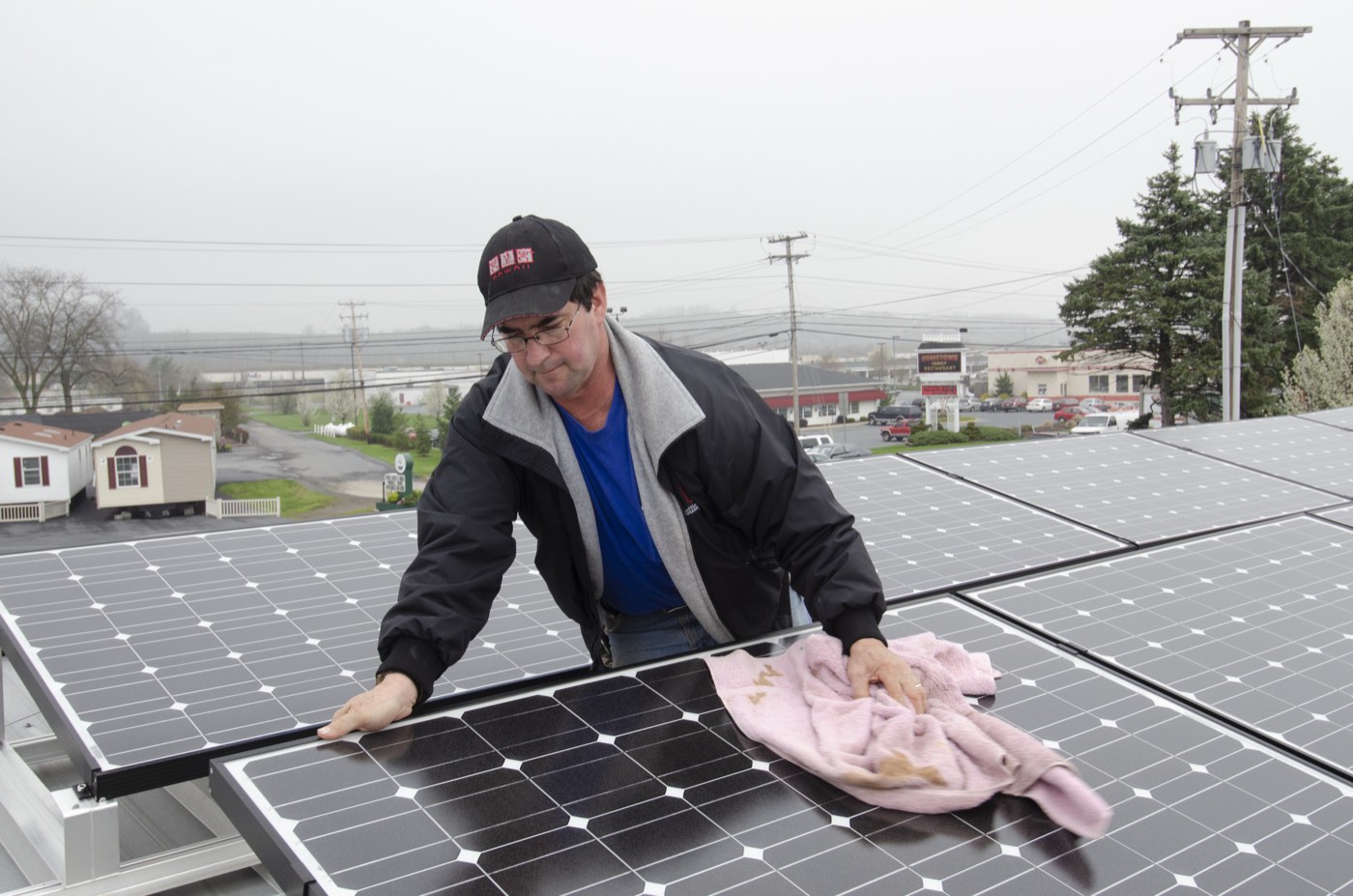
According to Airtasker’s cleaning cost data (dated June 4, 2025), a professional cleaning visit typically costs $150-$500, with most homeowners paying in the $250-$350 range — or roughly $8-$25 per panel, depending on roof access, panel count, and local labor rates. Airtasker’s data recommends cleaning twice a year, which puts a reasonable annual budget at $390-$720 for two visits, depending on where your actual per-visit cost falls in that range.
Whether you need professional cleaning at all depends on your situation. Panels on an accessible, low-pitch roof in a region with regular rainfall may stay clean enough without intervention, since rain does a reasonable job washing off ordinary dust. Panels on a steep roof, in a dusty or pollen-heavy region, or near agricultural or construction dust are the cases where scheduled cleaning does the most to protect production — dirt and debris buildup reduces the amount of sunlight reaching the cells, which lowers output until it’s cleared.
Professional inspection: $150-$350 per visit
A periodic system inspection — checking wiring, connections, mounting hardware, and panel condition — typically costs $150-$350, averaging around $200, according to Angi’s inspection cost data. If you want a more thorough check using thermal imaging or a drone survey to spot hot spots or cell damage not visible from the ground, add roughly $150-$200 on top of the base inspection cost.
Unlike cleaning, an inspection isn’t necessarily an annual expense for most homeowners — it’s more commonly done periodically, or triggered by a specific concern like a noticeable drop in production, storm damage, or an approaching warranty deadline where you want documented proof of system condition.
Inverter replacement: $1,200-$3,000, once every 10-15 years
This is the largest single maintenance cost most solar owners will face, and it’s also where the available data disagrees on specifics.
On lifespan, the sources align reasonably well: pv magazine USA, citing EnergySage data, reports that string inverters typically last 10-15 years, well short of the 25-30+ year rating on the panels themselves. That gap means most homeowners with a standard string inverter system should plan for at least one inverter replacement during the system’s usable life, even if the panels themselves keep producing well beyond that point.
On cost, the two sources available don’t fully agree. EnergyScout (dated June 16, 2026) cites $1,500-$3,000 installed for a typical 5-8kW residential system. GreenLancer cites the unit itself at $1,200-$1,800, plus $500-$1,500 in separate labor cost — which, combined, implies a total closer to $1,700-$3,300. These two figures are in the same general neighborhood but don’t line up precisely, likely reflecting differences in how each source defines “installed” cost and what labor assumptions they used. A reasonable combined planning range, acknowledging that disagreement rather than picking one source arbitrarily, is roughly $1,200-$3,000 installed — budget toward the higher end if your system uses microinverters (replaced individually but more numerous) rather than a single central string inverter.
Because this cost is infrequent but large, it’s worth budgeting for as a lump sum you’ll need once in the system’s first 10-15 years, rather than spreading it thin as an “annual” cost the way cleaning is.
What your warranty does and doesn’t cover
It’s worth being explicit about this because it’s a common source of confusion. A standard 25-year performance warranty guarantees that your panels won’t degrade in output faster than a specified rate over that period — if a manufacturer’s performance guarantee is violated, you may have a claim. What it does not cover:
- Routine cleaning. Dirt, dust, and debris accumulation are not manufacturing defects, so cleaning is always an out-of-pocket cost, warranty or not.
- Scheduled inspections. Checking your system’s condition is maintenance, not a warranty claim, unless the inspection itself uncovers an actual defect covered by the warranty’s terms.
- Inverter replacement, in most cases. Inverters typically carry their own separate warranty — often shorter than the panel warranty — and even within that window, normal end-of-life replacement after 10-15 years of service is not usually treated as a defect claim.
In short: the panel performance warranty and your ongoing maintenance budget are two separate things, and having one doesn’t reduce your need for the other.
Putting together an annual budget
For a typical residential system, a reasonable way to think about ongoing costs is:
- Every year: $390-$720 for twice-yearly cleaning (less if your roof stays relatively clean naturally, more if you’re in a dusty region or skip a visit and need extra work).
- Occasionally, as needed: $150-$550 for a professional inspection, more if you add thermal imaging or drone diagnostics.
- Once, likely in year 10-15: $1,200-$3,000 for inverter replacement.
None of these costs affect your system’s upfront price or your payback period calculation in a way most homeowners plan for in advance — building a modest annual maintenance reserve, rather than treating solar as a fully “set and forget” purchase, avoids being caught off guard by a cleaning bill or a larger inverter replacement years down the line.
Sources
- Airtasker, “Solar Panel Cleaning Cost” (dated June 4, 2025) — airtasker.com (consulted August 9, 2026)
- pv magazine USA, “How long do residential solar inverters last?” (August 5, 2025) — pv-magazine-usa.com (consulted August 9, 2026)
- EnergyScout, “Solar Inverter Lifespan” (dated June 16, 2026) — energyscout.io (consulted August 9, 2026)
- GreenLancer, “Solar Inverter Repair” — greenlancer.com (consulted August 9, 2026)
- Angi, “Solar Panel Inspection Cost” — angi.com (consulted August 9, 2026)
Frequently asked questions
How much should I budget per year for solar panel maintenance?
Twice-yearly professional cleaning runs roughly $390-$720 a year based on typical per-visit pricing of $150-$500. A periodic professional inspection adds $150-$350 when you get one, plus $150-$200 more if you add thermal imaging or drone add-ons. Inverter replacement is a larger, one-time cost of roughly $1,200-$3,000 that typically comes up once every 10-15 years rather than annually.
Does my solar panel warranty cover cleaning and maintenance?
No. Standard 25-year performance warranties cover the panels' power output degrading beyond a guaranteed threshold, not routine upkeep. Cleaning, inspections, and general maintenance are out-of-pocket costs on top of whatever warranty coverage you have, since a warranty claim requires the equipment to be underperforming or defective, not just dusty.
How often do solar inverters need to be replaced?
String inverters typically last 10-15 years, compared to panels rated for 25-30+ years, so most homeowners with a string inverter system should expect at least one inverter replacement over the system's lifetime. Microinverters, which are distributed at the panel level rather than centralized, are generally rated for longer service life, though that comes with a different upfront cost tradeoff.
How much does it cost to replace a solar inverter?
Sources disagree on the exact figure. EnergyScout cites $1,500-$3,000 installed for a 5-8kW system, while GreenLancer cites $1,200-$1,800 for the unit plus $500-$1,500 in labor. Combined, that puts a reasonable planning range at roughly $1,200-$3,000 installed, though the two sources don't fully agree on how the cost breaks down between equipment and labor.
Do solar panels need professional cleaning, or can I do it myself?
Many homeowners can safely rinse ground-level or easily accessible panels themselves with water and a soft brush. Professional cleaning becomes more worthwhile for steep or hard-to-reach roofs, where the $8-$25 per panel cost buys both proper equipment and the safety of not climbing onto your own roof.
Written by
ClearWatt Editorial TeamThe ClearWatt Editorial Team researches and writes every guide on this site. We work from primary sources — federal and state agencies (EIA, NREL, DSIRE, IRS), legislative text, utility rate schedules, and manufacturer documentation — rather than summarizing other websites' coverage of the same topic. We are not licensed solar installers, financial advisors, or tax preparers, and nothing published here is a substitute for advice from one. When a figure can't be traced to a specific, current source, we say so and give a range instead of a false-precision number. Articles are dated, and we correct confirmed errors promptly. See our Editorial Policy for the full standard every guide is held to, and About & Methodology for the sources we draw from.